
Frequently asked questions
The questions we get asked most, answered straight.
In short
This page answers 92 of the questions we are asked most about roofing: how long jobs take, when a repair is enough and when a roof needs replacing, what scaffolding is needed, and how quotes work. If your question is not here, call or WhatsApp 07464 695657.
General questions
Which areas do you cover?
E Stewart Roofing Ltd covers Glasgow, Kilmarnock, Ayr, Troon, Irvine, Prestwick, Cumnock, East Kilbride, Paisley, Hamilton, Greenock, Gourock, Port Glasgow, Largs, Kilwinning, Ardrossan, Saltcoats, Newton Mearns, Bearsden, Milngavie, along with the wider Ayrshire, Inverclyde, Renfrewshire, East Dunbartonshire and Lanarkshire areas. If you are not sure whether you are in range, call 07464 695657 and ask.
How long have you been trading?
E Stewart Roofing Ltd has been working on roofs across Glasgow and Ayrshire for over 19 years. It is a family-run company, and the owner, Ewan Stewart, is on the tools and involved in the jobs rather than running things from an office.
How do I get a quote?
Call 07464 695657, WhatsApp 07464 695657, or use the quote form on the contact page, which opens WhatsApp with your details already written out. Sending a photograph of the problem is the fastest way to get a useful answer, because a lot can be told from a clear picture of a roof.
Do you charge for a quote?
Quotes are free and there is no obligation to go ahead. You get told what needs doing and what it will cost before any work starts.
Are you insured?
Yes. E Stewart Roofing Ltd carries public liability insurance, and the cover level is confirmed in writing on request before work starts.
Do you guarantee your work?
Yes. Depending on the job, work is guaranteed for up to 20 years. The guarantee that applies to your specific job is confirmed in writing with your quote, because a full re-roof and a single slate repair are not the same thing.
How big is your team?
There are six of us: Ewan, roofers Jamie, Stuart and Richard, and joiners Paul and Tony. That is enough to strip and re-cover a roof properly and keep a job moving, while staying small enough that you deal with the same people from the quote to the sign off.
Do you do emergency call-outs?
Active leaks are treated as urgent, because water sitting in a ceiling does far more damage than the fault that let it in. Call 07464 695657 and you will be told honestly how soon someone can get to you.
Can you tell what is wrong from a photograph?
Often yes, at least well enough to say whether it is a small repair or something bigger. A photo of the affected area plus one of the whole elevation is usually enough for an initial view, though anything serious still needs looking at properly.
Do you do roughcasting as well as roofing?
Yes. Roughcasting and exterior rendering are a core part of what we do alongside the roofing, which matters on Scottish property where the walls take as much weather as the roof. We also have two joiners on the team, so structural timber work is handled in house.
Will you tell me if I do not need the work?
Yes. If a roof has years left in it and only needs a repair, that is what you will be told. Selling someone a new roof they do not need is a short-term way to run a business, and reputation is what brings the next job in.
Do you work on tenements and traditional stone property?
Yes. Traditional Glasgow and Ayrshire stone property is a large part of the work, and it needs handling differently from modern housing: lime mortar rather than hard cement, matching slate rather than whatever is cheapest, and lead detailing done properly around the stacks and valleys.
Do you need scaffolding for every job?
No. Small repairs are often done from ladders or a tower. A full strip and re-cover cannot be done safely without proper access, and where scaffolding is needed the cost of it is in the quote rather than added on later.
Do you work on commercial buildings as well as houses?
Most of the work is domestic, and commercial, landlord and factor work is taken on too. Call with the details and you will get a straight answer on whether it is a job for us.
Where can I read your reviews?
E Stewart Roofing Ltd has 61 reviews on Google averaging 4.9 out of 5. A selection is on the reviews page of this site, word for word, and the full set is on the Google Business Profile.
How do I know the work has been done properly?
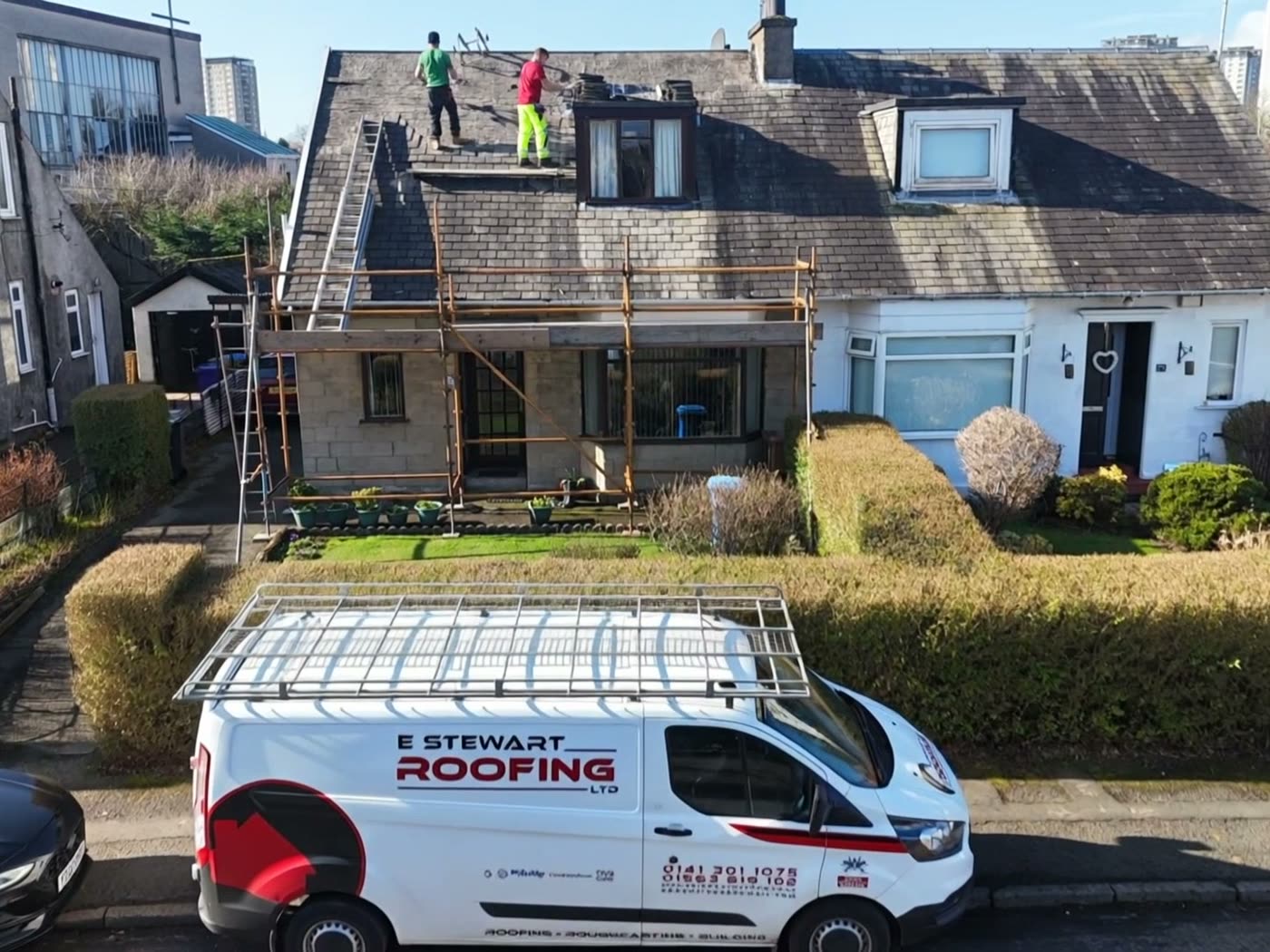
Jobs are photographed as they go, so you can see the parts of the work you cannot get to yourself. Every photograph and video on this website is from a job carried out by E Stewart Roofing Ltd.
Roof repairs in Glasgow and Ayrshire
Slipped slates, leaks, valleys and flashings put right before they get worse. Read more about roof repairs in glasgow and ayrshire.
How quickly can you look at a leak?
Call or WhatsApp 07464 695657 and we will tell you honestly how soon we can get to you. Active leaks in wet weather are treated as urgent, because water sitting in a ceiling causes far more damage than the fault that let it in.
Can you repair a roof in the rain?
A temporary cover can usually go on straight away to stop water getting in, but permanent work such as bedding mortar or dressing lead needs dry conditions to be done properly. In Scotland that often means working around the forecast rather than against it.
Is it worth repairing an old roof?
If the covering is sound and the problem is in one area, a repair is much better value. Once slates are slipping in several different places and the sarking underneath has broken down, repeated repairs cost more over a few years than replacing the roof once.
Do you find the leak before quoting?
Yes. Quoting for a roof leak without establishing where the water is actually getting in is guesswork, and it is how people end up paying for work that does not fix the problem.
Why does my roof only leak in driving rain?
That usually points to a fault that only lets water past at a certain angle or volume, such as a gap under a flashing, a hairline crack in a slate, or a valley that overtops when it fills. It is a real fault and it will get worse, even though the roof seems fine most of the time.
New roofs and re-roofing
Full strip and re-cover in slate or tile, from the timbers up. Read more about new roofs and re-roofing.
How long does a new roof take?
On a standard semi-detached house a full re-roof is usually a few days on site once scaffolding is up, and longer on larger or more complicated roofs. Weather is the main thing that moves the date, because a stripped roof cannot be left open in heavy rain.
Do I need scaffolding for a re-roof?
Yes. A full strip and re-cover cannot be done safely off ladders, and scaffolding is needed both for the people working and to stop material falling. The cost of it should be in your quote rather than added on later.
Slate or tile, which should I choose?
It usually comes down to what is already on the house and what the rest of the street has, because a roof that matches looks right and keeps the property saleable. Natural slate lasts longest and suits Scottish period property; concrete and clay tiles cost less and suit most modern housing.
Can you re-roof in winter?
Yes, roofs are replaced all year round in Scotland. Work is planned around the forecast and the roof is never left open overnight, so a wet spell can push the finish date back a little.
Do I need planning permission to replace a roof?
Replacing a roof with a similar covering is normally treated as maintenance and does not need planning permission. It is different if the property is listed or in a conservation area, or if you are changing the roof shape or material significantly, so check with the council first.
Can you fit roof windows or solar at the same time?
Yes, and it is by far the best time to do it. Setting roof windows or integrated solar into a covering that is already coming off means the flashings and the surrounding slate are formed around them properly, rather than cut in afterwards.
Slate and tile roofing
Natural slate, reclaimed slate and tile, laid to last on Scottish property. Read more about slate and tile roofing.
How long does a slate roof last?
A well laid natural slate roof can last a hundred years or more. In practice what fails first is rarely the slate: it is the nails, the sarking underneath, or the lead work, which is why an old roof can often be re-covered using much of the original slate.
Can you reuse my existing slates?
Often yes. Good natural slate is worth saving, and on a strip and re-cover we sort what comes off, keep what is sound, and make the numbers up with matching reclaimed or new slate. Slate that is delaminating or badly holed is not worth putting back.
What is nail sickness?
It is when slates start slipping because the fixings have rusted through, even though the slates themselves are still perfectly good. It shows up as slates coming off in different places every winter, and it means the roof needs re-covering rather than repairing again.
Is slate better than tile?
For Scottish period property, slate is usually the right answer on looks, longevity and matching the street. For most post-war housing, concrete or clay tile does the job at lower cost. The wrong choice is putting a heavy covering on a roof structure never designed to carry it.
Do you work on tenements and traditional stone property?
Yes. Traditional Glasgow and Ayrshire stone property is a large part of what we do, and it comes with its own detailing: shared valleys, substantial stacks, skews and cast iron rainwater goods that need working around rather than ripping out.
Flat roofing
Extensions, dormers, garages and porches covered in modern membrane. Read more about flat roofing.
How long does a rubber flat roof last?
A properly installed single ply membrane on a sound deck is generally expected to give decades of service rather than the ten or fifteen years people associate with old felt roofs. What shortens it is almost always the deck or the falls underneath, not the membrane.
Can you put a new flat roof over the old one?
Sometimes, but it is usually a false economy. Covering over a wet or rotten deck traps the moisture and the new roof fails early. We take the old covering off so the deck can actually be seen.
Why does water sit on my flat roof?
Because the falls are not steep enough or run the wrong way. A flat roof is never truly flat: it needs a fall to the outlet. Standing water is the single most common reason a flat roof fails early, and it can usually be corrected when the roof is recovered.
Can a flat roof be repaired rather than replaced?
Yes, if the deck is sound and the fault is a split, a seam or an edge detail. If the deck has gone soft underfoot or water has been getting in for a long time, a repair is only buying a little time.
Do you cover dormers and porches as well as extensions?
Yes. Dormers, porches, garages, bay roofs and small link roofs are all flat roofing work, and the small ones often matter most because they sit directly above a room you use.
Emergency roof repairs
Storm damage, active leaks and anything that cannot wait for the weather. Read more about emergency roof repairs.
How fast can you get to an emergency?
It depends where you are and what else is running that day, but you will be told honestly rather than strung along. Call or WhatsApp 07464 695657 with a photo and your postcode and you will get a realistic answer.
Can you make a roof safe in a storm?
Making a roof safe from the ground, such as cordoning off an area where material could fall, can be done in almost any weather. Going onto a roof in high wind is not safe for anyone, so work up top waits until the wind drops.
Will my insurance cover storm damage?
Storm damage is commonly covered, though it depends on your policy and on the roof having been in reasonable condition beforehand. We photograph the damage as we find it so you have evidence for the claim, but we cannot tell you what your policy will pay.
Do you charge more for emergency call-outs?
You will be told what the visit costs before anyone comes out, so there are no surprises on the invoice. What we will not do is use an emergency as a reason to inflate a price.
What should I do while I wait?
Move what you can out from under the leak, put a container down, and if a ceiling is bulging with trapped water, keep out from under it. Do not go up a ladder in bad weather to look at it yourself.
Chimney repairs and rebuilds
Repointing, rebuilds, flaunching and lead flashings on the stack. Read more about chimney repairs and rebuilds.
Why is my chimney breast damp?
Most often because the flashing where the stack meets the roof has failed, or because the masonry itself is so porous that it is soaking through. An old cement fillet cracking away from the stack is one of the most common causes on Scottish property, and it is a straightforward fix.
Should a cement fillet be replaced with lead?
Yes, wherever possible. Cement fillets crack because cement and masonry move at different rates, and once cracked they funnel water straight into the stack. Lead soakers and a stepped flashing move with the building and last far longer.
Can you take a chimney down instead of repairing it?
Yes, where a stack is redundant it can be taken down and the roof made good over it. It is worth thinking it through first, because stacks are part of the look of traditional property and removing one is not easily undone.
Do I need a chimney repaired if I never use the fire?
Yes. A disused stack still takes the same weather, and it still lets water into the building when the flashing or the flaunching fails. Capping the pots while leaving ventilation is often sensible on a stack that is no longer in use.
How long does chimney work take?
Repointing and flashing work on a single stack is often a day or two once access is sorted. A full rebuild takes longer and needs scaffolding, and the weather has to be reasonable because new mortar cannot be laid in a hard frost.
Leadwork and lead flashing
Valleys, soakers, stepped flashings and abutments, dressed properly. Read more about leadwork and lead flashing.
How long should leadwork last?
Correctly sized and fixed lead should outlast most of the roof around it and run for many decades. Lead that fails within a few years has nearly always been laid in sheets that are too long, in too thin a code, or bedded in cement.
Can lead flashing be repaired or does it need replacing?
A single small split can sometimes be dressed and patched, but if lead is cracking it is usually because it was wrong to begin with, and patching leaves the same fault in place. Replacing the run properly is normally the better spend.
What is a soaker?
A soaker is a small piece of lead that sits under each course of slate or tile where the roof meets a wall, working with the stepped flashing over the top of it. Soakers are hidden once the roof is finished, which is exactly why they get left out by people cutting corners.
Is lead still allowed on roofs?
Yes. Lead remains the standard material for roof flashings and valleys in the UK, and there is no restriction on using it in this way. It is durable, fully recyclable and, fitted correctly, still the best answer for these details.
Why has someone used cement instead of lead on my roof?
Because it is quicker and cheaper to do. A cement fillet looks acceptable when it is new and cracks within a few winters, at which point it channels water into the joint it was supposed to protect.
Gutters, fascias and soffits
Clearing, repairing and replacing the whole rainwater line. Read more about gutters, fascias and soffits.
How often should gutters be cleared?
Once a year is enough for most houses, and twice a year where there are trees close by. In the west of Scotland autumn leaves and moss washing off the roof are the two things that block a gutter fastest.
Can you repair cast iron guttering?
Yes, and it is usually worth it. Cast iron lasts a very long time if it is kept clear and painted, and it suits traditional property far better than plastic. Individual sections can be replaced where they have cracked.
Do fascias and soffits need replacing at the same time as the gutter?
Not always, but often. If the gutter has been overflowing for a while the fascia behind it has usually taken the water, and putting a new gutter onto a rotten board just means doing the job twice.
Why does my gutter overflow only in heavy rain?
Usually either a partial blockage further along the run, or a fall that is not steep enough to move water fast enough when it really comes down. Both are fixable without replacing the guttering.
Can you do gutters without scaffolding?
Clearing and small repairs can normally be done from ladders or a tower. A full replacement along a two storey elevation is usually safer and quicker with proper access, and that will be in the quote.
Roughcasting and harling
Traditional roughcast and harling, patched or renewed across the elevation. Read more about roughcasting and harling.
What is the difference between roughcast and harling?
In practice they refer to the same thing: a wet mix thrown onto the wall to give a textured, weather-shedding finish. Harling is the older Scottish term and roughcasting is the one most people use day to day.
Can roughcast be patched or does the whole wall need doing?
Small areas can be patched, and it is the sensible thing to do where the rest of the elevation is sound. The trade-off is that a patch rarely matches perfectly in texture and colour, so where a large proportion has blown, doing the whole elevation gives a much better result.
Why has my roughcast cracked?
Usually movement, water getting in behind it, or a mix that was too strong for the wall underneath. A strong cement render on a soft traditional wall will crack because the wall moves and the render will not.
Can you paint roughcast?
Yes, with a breathable masonry paint. What causes problems is painting over cracked or blown render with a non-breathable coating, which traps moisture in the wall and makes the damp worse rather than better.
What time of year can roughcasting be done?
It needs reasonable conditions to cure, so it is not done in a hard frost or in driving rain. Spring through autumn is the natural window in Scotland, though sheltered elevations can often be worked on outside that.
Exterior rendering
Smooth and textured render, made to suit the wall behind it. Read more about exterior rendering.
How long does render last?
A correctly specified and applied render should last for decades. Where render fails early it is almost always because the mix was too strong for the wall, the preparation was skipped, or it was applied in the wrong conditions.
Can you render over old render?
Only if the existing render is sound and well bonded across the whole area. If parts of it are hollow, rendering over the top just means the new work comes off with the old.
Will rendering fix my damp problem?
Sometimes, where the damp is genuinely wind-driven rain coming through a porous wall. It will not fix rising damp or a leak from a gutter or a roof, and rendering over those problems traps the moisture in.
Do I need planning permission to render my house?
Usually not for a normal house, but listed buildings and properties in conservation areas are treated differently, and some estates have conditions attached. Check with the council before committing.
What is the difference between render and roughcast?
Render is the general term for a wet coating applied to a wall, and it can be finished smooth or textured. Roughcasting is a specific Scottish finish where the final coat is thrown on to give a rough texture.
Storm damage repairs
Wind-lifted slates, ridge damage and insurance work after a named storm. Read more about storm damage repairs.
Should I claim on my insurance for storm damage?
It depends on the size of the repair against your excess, and on your policy. We photograph what we find so you have the evidence either way, but we cannot advise on your policy or deal with the insurer on your behalf.
What counts as storm damage?
Insurers generally look for damage caused by unusually severe weather rather than gradual deterioration. That is why a roof that was already in poor condition can be harder to claim on, and why photographs of the actual damage matter.
Can you make my roof safe today?
Often yes for the make-safe part, depending on where you are and how busy the day is. Going onto a roof in high wind is not safe, so anything up top may have to wait for the wind to drop.
My neighbour lost slates and I did not. Should I get mine checked?
It is worth doing. Wind lifts material that was already marginal, so a storm often loosens slates and ridge tiles that have not actually come off yet. Catching those is a lot cheaper than the next storm taking them.
Do you handle the insurance paperwork?
We provide a written quote and photographs of the damage, which is what most insurers ask for. Submitting and managing the claim itself is between you and your insurer.
Dry ridge and dry verge systems
Mechanically fixed ridges and verges that do not rely on mortar. Read more about dry ridge and dry verge systems.
Is a dry ridge better than mortar?
For durability and for wind resistance, yes. Mortar relies on a rigid bond that eventually cracks under thermal movement and weather. A mechanical fixing does not, and it adds ventilation along the ridge as a bonus.
Can a dry ridge be fitted to an existing roof?
Yes. It is one of the most common upgrades on an older roof, and it does not require re-covering the whole thing. The ridge is lifted, the system goes in, and the tiles go back down mechanically fixed.
Will it look different?
Barely. The tiles sit in the same place and look the same from the ground. The visible difference is that the mortar line is replaced by a neat closure under the tile edge.
Does a dry ridge help with condensation?
It helps. Ridge ventilation lets warm moist air out at the top of the roof space, which is where it collects. It is not a complete answer on its own if the loft has other ventilation or insulation problems.
How long does a dry ridge take to fit?
On a typical house it is usually a day or so, depending on the length of the ridge and any hips, and on access.
Repointing
Chimneys, gables and elevations raked out and pointed in the right mix. Read more about repointing.
How often does a wall need repointing?
Good pointing lasts a long time, often several decades. It depends heavily on exposure: a west-facing gable in Ayrshire takes far more weather than a sheltered rear elevation, and it will need attention sooner.
Why is lime mortar used on old buildings?
Because it is softer than the stone and lets moisture escape through the joint. Hard cement pointing traps water in the wall and forces it out through the face of the stone, which then spalls and is very expensive to put right.
Can you repoint just one area?
Yes, and it is often the sensible thing to do. The finish is matched as closely as possible, though a patch on a weathered wall will always be slightly visible until it beds in.
Will repointing stop my damp?
It will if the damp is coming through open joints, which is common. It will not fix a leaking gutter, a failed flashing, or rising damp, so it is worth establishing the cause before spending money on the wall.
Can repointing be done in winter?
Not in a hard frost. New mortar that freezes before it has cured will fail, so this work is planned around the weather.
Roof cleaning and moss removal
Moss and debris removed without damaging the covering. Read more about roof cleaning and moss removal.
Should I pressure wash my roof?
We would not advise it. High pressure strips the protective surface off concrete tiles, can crack slate, and drives water up underneath the covering. The damage often costs far more than the cleaning saved.
Does moss actually damage a roof?
It holds moisture against the covering, blocks the gutters as it breaks up, and in a hard frost expands in the joints. On a sound roof it is a maintenance issue rather than an emergency, but it does shorten the life of the covering.
Will the moss come back?
Yes, eventually, particularly on a shaded or north-facing slope in this climate. Clearing it every few years is normal maintenance rather than a sign the job was done badly.
Can you clean the roof and check it at the same time?
That is the sensible way to do it. Moss hides slipped and cracked slates, so anything found underneath gets reported with photographs while we are up there.
Is it worth cleaning a roof before selling a house?
It makes a real difference to how the property presents, and a clean roof and clear gutters suggest a house that has been looked after. It will not hide a roof that needs replacing.
Roof inspections and reports
A straight answer on the condition of a roof, with photographs. Read more about roof inspections and reports.
Do you charge for a roof inspection?
Quotes for work are free. Where you want a full inspection and written report on a roof, for example before buying a property, that is a separate piece of work and you will be told the cost before we come out.
Can you tell what is wrong from a photograph?
Often well enough to say whether it is a small repair or something bigger. A photo of the affected area plus one of the whole elevation is usually enough for an initial view, though anything serious still needs looking at properly.
My survey says the roof is at the end of its life. Is that right?
Sometimes, and sometimes not. Home surveys are usually done from the ground with binoculars, and they are deliberately cautious. Getting on the roof often gives a very different and more useful answer.
How long does an inspection take?
Usually an hour or so on a typical house, longer on a larger or more complicated roof, or where the loft access is awkward.
Will you tell me if I do not need the work?
Yes. If a roof has years left in it and only needs a repair, that is what you will be told. Selling someone a roof they do not need is a short-term way to run a business.
Still not sure?
Call 07464 695657 or send a photo on WhatsApp and you will get a straight answer.